 SOUTH HANNINGFIELD PARISH COUNCIL
History of South Hanningfield
South Hanningfield is the smallest of the three villages which form the parish of South Hanningfield.
The name of Hanningfield means a portion of cleared forest land which was once owned by the family Hann or Ham, who was thought to be a Saxon tribal leader. At the Norman conquest the lordship of the manor of Hanningfield was given to the Bishop of Bayeaux and later, in the 16th century, descended through the Montchesney family to John, the first baron Petre of Writtle, and has remained in the family to the present day.
The centre of the village is situated around the Tye (village green) which is on the road junction of South Hanningfield Road, which runs from Downham to Rettendon Common, and Middlemead which leads to West Hanningfield.
Today, the most predominant feature of the landscape is the Hanningfield reservoir. This includes a large picnic area with public car parking, a trout fishing lodge, and a public waterside cafe. The reservoir is covered by a Bird Sanctuary Order and facilities for bird watching have proved to be an extremely popular attraction
It wasn’t always like this though, at the time of the First World War the village consisted of the school, The Windmill Public House, St Peter’s Church, the post office and general store, the blacksmiths’ and Bearmains.
After the First World War a Village Hall was erected and a men’s club and Women’s Institute was formed.
Prior to the Second World War the men in the village worked 6 days a week on the land or in related industries and the women were busy looking after their large families. Nobody really went outside the village boundaries unless they went to stay with their relations in nearby villages. The men used to go the Windmill Public House on Saturday evenings and on Sundays most people went to Church.
During the Second World War women were drafted into industry, the forces or to work on the land, so they were no longer confined to the village. The men were enlisted into the forces and sent all over the world, many never to return.
Villagers celebrated the end of the Second World war with a large bonfire and Village Hall dance.
Major change came to the village, which was reduced to about half its size, in 1951 when the Hanningfield reservoir was built by the South Essex and Southend Waterworks companies. This covered the ancient hamlet of Peasdown and several buildings in the local area were demolished to make way for the reservoir. Contrary to popular local belief there are no buildings left under the reservoir just one earth moving machine which was covered in concrete. Once the reservoir was built it took two hundred days to fill and when at maximum capacity the reservoir storage is the equivalent of 10,430 Olympic-sized swimming pools. The water treatment works went into production in August 1956 & the works were officially opened in Sept 1957.
Today the water held there supplies 540,000 homes which is about 1.5 million people. Surrounding the reservoir and treatment works is 250 acres of woodland which includes some notable large oak trees. Hanningfield Nature Reserve was first set up in 1992 & The Waters Edge (now Café on the Water) was opened in Easter 2007.
TV personality Chris Tarrant, footballer David Seaman and cricketer Keith Fletcher have all fished at Hanningfield.


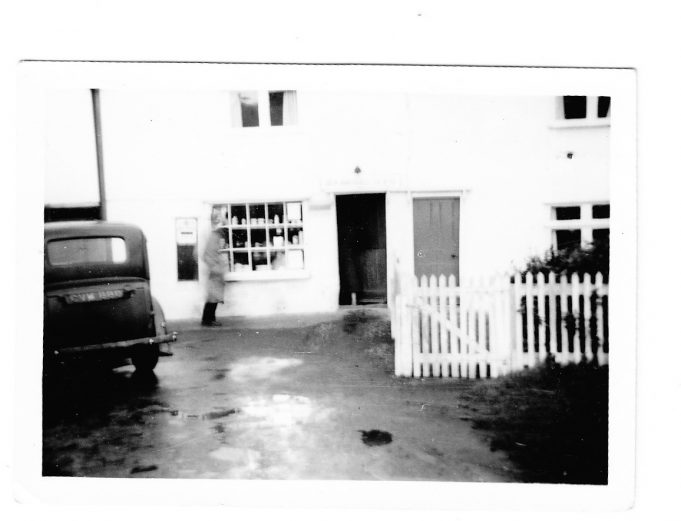

A selection of old photographs above sourced from Wickford History website. More photos are available here – https://www.wickfordhistory.
The Old Windmill Pub website has the following lovely old photo of the pub, together with the pub’s history – https://www.brunningandprice.co.uk/oldwindmill/history/


